Quick answer: The Facebook page vs website choice is not either-or: social media can support discovery, while an owned website gives the business a stable home.
Important: Search visibility, enquiries, conversion, costs and revenue vary by market, offer, competition, execution and other factors. Examples are for planning only and are not guarantees of results.
Every week, I hear from local service business owners who ask the exact same question:
"I already have an active Facebook page with 1,200 followers and an Instagram profile. Why should I spend money on a website?"
It sounds like a reasonable question on the surface. Setting up a social profile is free. Posting photos takes thirty seconds on your smartphone. You might even pick up occasional direct message inquiries from friends or neighbors.
Here is the plain truth: treating social media as a replacement for an owned website is one of the most dangerous gambles a business owner can make.
Social media platforms are not designed to grow your business. They are designed to keep users trapped inside their feed so they can sell advertising space. When you rely solely on social media, you are running your business on borrowed time and rented infrastructure.
Let’s look at the operational reality of how this hurts your bottom line.
1. The Algorithm Tax: Organic Reach Is Dead
Ten years ago, when you posted an update on your Facebook business page, a healthy percentage of your followers saw it in their feed.
Today, organic reach on Meta platforms hovers between a variable percentage and a variable percentage.
If you spent three years building a following of 2,000 local residents, fewer than 50 of them will ever see your latest project update or promotion unless you pay to "boost" the post.
Think about the absurdity of that model:
- You did the hard work of acquiring the follower.
- The platform charges you a toll just to speak to the person who already asked to hear from you.
- The moment you stop feeding money into their ad system, your visibility drops back to zero.
On an owned website, you pay no algorithm tax. When you publish a service page, a case study, or a guide, it sits permanently on your domain. It gets indexed by search engines, attracts organic search traffic month after month, and delivers qualified visitors without demanding daily ad spend.
2. Search Intent vs. Idle Scrolling (The Psychology of the Buyer)
The biggest difference between a website and a social media page comes down to user intent.
When someone is browsing Instagram or Facebook at 9:00 PM, what are they doing?
They are relaxing, watching short videos, checking in on friends, or scrolling out of boredom. They are in passive consumption mode. If your sponsored ad or post flashes past them, you are interrupting their entertainment. Conversion rates on cold, passive social traffic are notoriously low.
Now consider what happens when a homeowner's furnace stops blowing hot air in the middle of January.
They do not open Instagram to look at aesthetic reels of furnace motors.
They go directly to Google and type: "emergency furnace repair near me."
That searcher has:
- An urgent, high-stakes problem.
- An active intent to hire a professional immediately.
- A credit card ready to pay for the solution.
Google does not serve Facebook photo albums for emergency service queries. It serves verified local businesses with clean, indexable websites. According to research from the Pew Research Center, while social media usage is widespread for entertainment and networking, search engines remain the dominant utility for commercial discovery and local hiring decisions.
3. The Digital Landlord Risk: Zero Ownership and Sudden Lockouts
What happens to your business if your social media account is hacked, flagged by an automated moderation bot, or suspended without warning?
For thousands of small business owners every year, the answer is catastrophic: their lead flow vanishes in five seconds.
Meta and TikTok offer virtually zero live customer support for small business accounts. If an automated algorithm flags your account by mistake, you can spend months shouting into an automated support void while your inbox sits dead.
Your Facebook page is not your property:
- You do not own the platform.
- You do not own the follower database.
- You cannot export your audience's email addresses.
- You have no legal rights if the platform changes its terms, restricts your features, or shuts down.
A website built on an independent domain (such as a .ca domain through the Canadian Internet Registration Authority (CIRA)) is an asset you legally own. You own the server files, the customer contact lists, the content, and the brand equity. Nobody can deplatform you or turn off your lead capture forms.
4. The 10-Second Credibility Gap
Imagine a general contractor bidding on a commercial office renovation. The property manager receives three quotes.
- Contractor A: Provides a proposal accompanied by an official website link with dedicated pages for past commercial builds, safety certifications, client testimonials, and a custom corporate email address (contact@contractor.ca).
- Contractor B: Sends an estimate from a personal @gmail.com address and attaches a link to a Facebook page filled with casual posts and memes.
Contractor B immediately looks like an uninsured weekend side-hustler.
5. Conversion Rate Optimization: Focus vs. Distraction
A social media page is designed to keep users on the social network. It is packed with distractions:
- Notifications popping up at the top of the screen.
- Suggested posts and trending videos in the sidebar.
- Sponsored ads from your direct competitors placed directly under your photos.
When a prospective client visits your Facebook page, they are one tap away from getting distracted by a video or clicking on a competitor’s ad.
In contrast, a custom-built website has one job: guiding a qualified visitor toward taking action.
On your website:
- There are no competitor advertisements.
- There are no distracting social notifications.
- Clear calls-to-action (Click-to-Call buttons, quote request forms, scheduling links) guide the user through a frictionless funnel.
A focused landing page converts visitors into phone calls and booked appointments at a rate three to five times higher than an unorganized social feed.
The Verdict: Social Media is a Megaphone, Your Website is the Cash Register
This is not an argument to delete your social media profiles. Social media has a clear, valuable role in modern marketing:
- It is great for sharing quick behind-the-scenes updates.
- It is useful for staying in touch with past clients.
- It works as an auxiliary discovery channel.
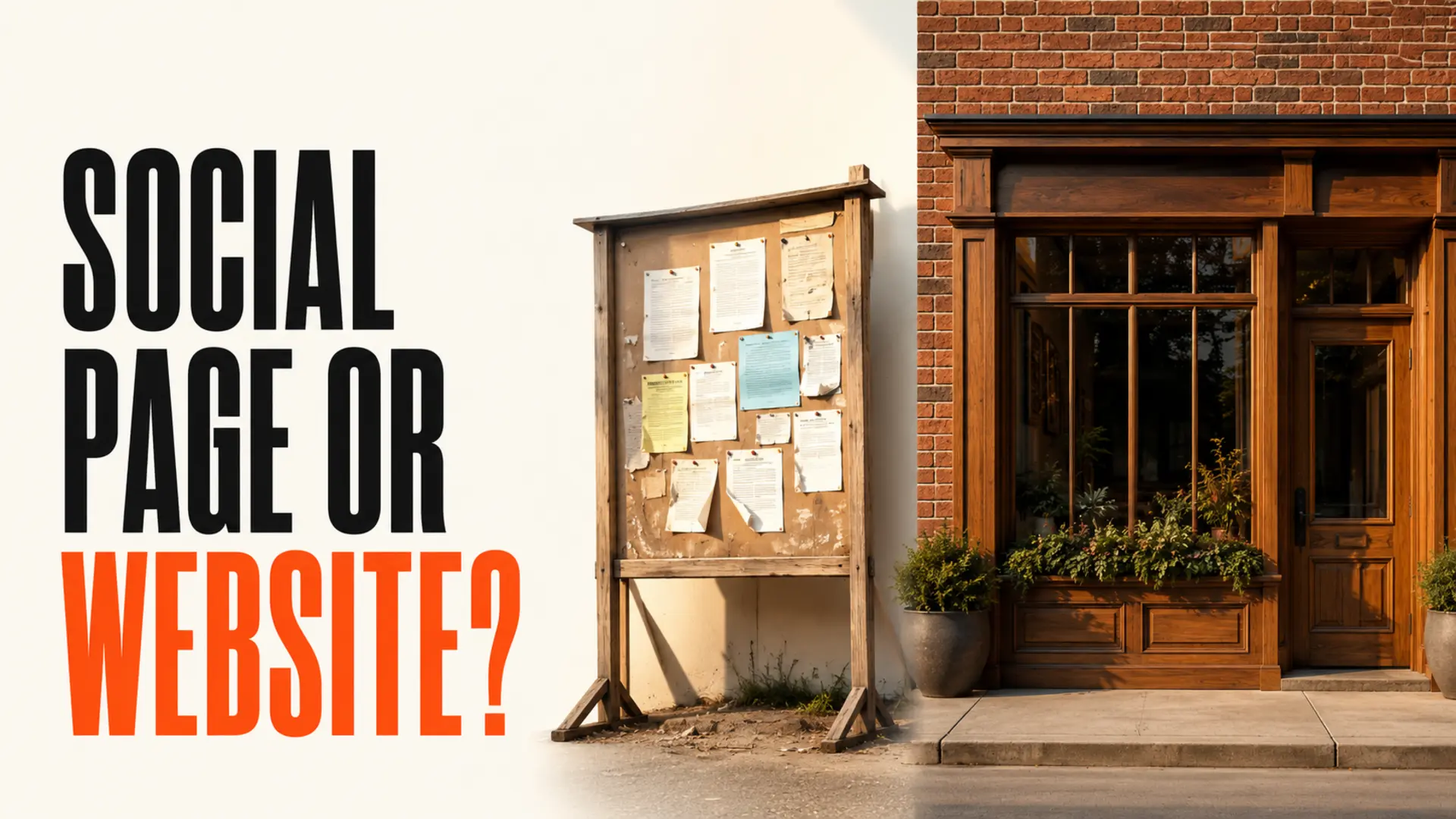
The practitioner move is to understand the hierarchy: Social media is the megaphone; your website is the cash register.
You use social platforms to direct interested attention back to your owned asset—your website. That is where visitors read detailed service breakdowns, review verified case studies, and submit high-intent quote requests.
The Practitioner Move: Building Your Owned Foundation
If your business has been relying exclusively on a Facebook page or Instagram profile, the fix is straightforward:
1. 1. Register Your Custom Domain: Lock in your brand’s .ca or .com address so you own your digital identity. 2. 2. Build a Lean 5-Page Web Foundation: Launch a fast, clean site featuring your primary services, service areas, customer testimonials, and a simple contact form. 3. 3. Link Your Social Channels to Your Site: Update your social profile bios to send all traffic to your dedicated quote page.
At TruWebz Studios Inc., we build high-performing, conversion-focused websites and local SEO systems that transform casual social browsers into serious paying customers. We eliminate bloated agency fees and complicated technical jargon so you can own a reliable digital asset that works for you 24/7.
Explore our straightforward web design and SEO solutions at TruWebz.ca and stop leaving your business’s future in the hands of social media algorithms.
Authoritative reference: For current guidance on how search engines discover and understand website content, see Google’s SEO Starter Guide.
Related TruWebz Resources
- business website design services
- SEO services for growing businesses
- why website traffic may not become leads
Ready to Build a Stronger Online Presence?
Talk with TruWebz about a faster, clearer website built to attract and convert the right customers.
Frequently Asked Questions
What is the Algorithm Tax: Organic Reach Is Dead?
There is no universal result. Evaluate the decision using your own market evidence, operating capacity, costs and applicable professional advice.
How do Search Intent and Idle Scrolling (The Psychology of the Buyer) compare?
The biggest difference between a website and a social media page comes down to user intent. When someone is browsing Instagram or Facebook at 9:00 PM, what are they doing?
There is no universal result. Evaluate the decision using your own market evidence, operating capacity, costs and applicable professional advice.
What is the Digital Landlord Risk: Zero Ownership and Sudden Lockouts?
What happens to your business if your social media account is hacked, flagged by an automated moderation bot, or suspended without warning? For thousands of small business owners every year, the answer is catastrophic: their lead flow vanishes in five seconds.
There is no universal result. Evaluate the decision using your own market evidence, operating capacity, costs and applicable professional advice.
What is the 10-Second Credibility Gap?
There is no universal result. Evaluate the decision using your own market evidence, operating capacity, costs and applicable professional advice.
How do Conversion Rate Optimization: Focus and Distraction compare?
A social media page is designed to keep users on the social network. It is packed with distractions: Notifications popping up at the top of the screen.
There is no universal result. Evaluate the decision using your own market evidence, operating capacity, costs and applicable professional advice.
What is the Verdict: Social Media is a Megaphone, Your Website is the Cash Register?
This is not an argument to delete your social media profiles. Social media has a clear, valuable role in modern marketing: It is great for sharing quick behind-the-scenes updates.
There is no universal result. Evaluate the decision using your own market evidence, operating capacity, costs and applicable professional advice.