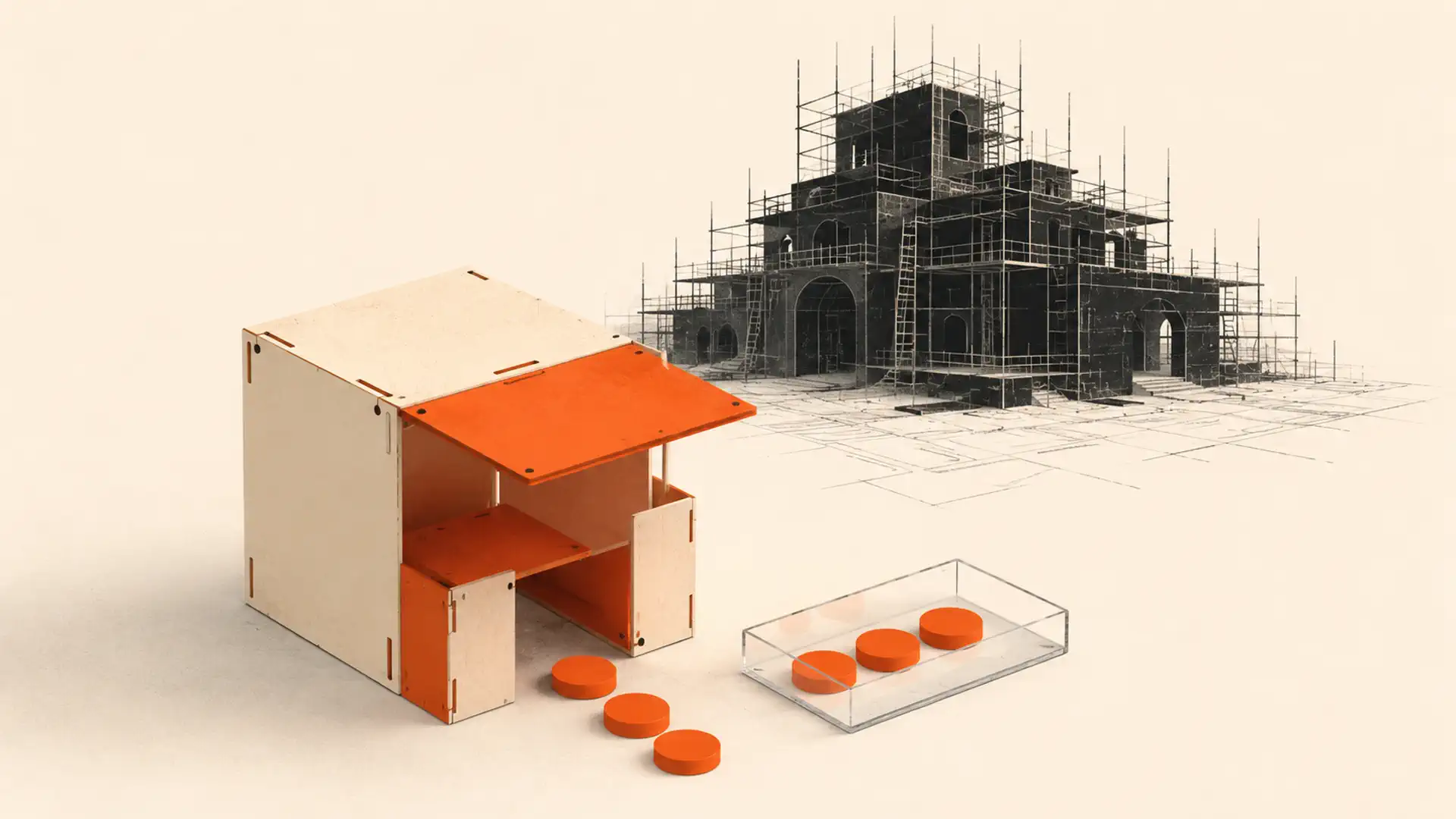
Short version: You do not need a $20,000 website to test a business idea. You need the smallest credible website that explains one offer, reaches the intended audience, captures a meaningful response and gives you evidence for the next decision. The appropriate budget depends on scope; validation should happen before expensive custom features.
Testing a business idea with an MVP website is not about building a cheaper version of the final product. It is about answering the riskiest question with the least unnecessary work. Will the right customer understand the offer, trust it enough to respond and take the action you need to measure?
A large website may eventually be justified. But committing to complex design, integrations and custom software before confirming demand can lock money into assumptions. A lean launch gives you room to learn while preserving budget for research, outreach and improvements.
What an MVP website needs to prove
Before choosing pages or technology, write down the decision the test should support. Examples include:
- Do people in the target market understand the offer?
- Will qualified prospects request a consultation, quote or demonstration?
- Which customer segment responds most strongly?
- Which objection prevents people from continuing?
- Can the business deliver the service manually before automating it?
These are evidence questions. Traffic by itself is not validation, and a compliment is weaker than a concrete action. Decide in advance which behaviours matter: completed interviews, qualified enquiries, pilot commitments, deposits where legally appropriate, or repeated use of a manual service.
The minimum useful scope for testing a business idea
Many service concepts can be tested with one focused landing page or a compact website. The exact structure depends on search intent and buyer risk, but a useful MVP commonly includes:
A clear offer
State who the service is for, what problem it addresses and what the visitor should do next. Avoid vague claims such as “innovative solutions.” Use language collected from customer conversations.
Enough proof for the decision
Use only evidence you can substantiate: relevant experience, a real process, product photographs, professional credentials, policies or a transparent pilot description. Do not invent testimonials, client logos, results or certifications to make an early idea appear established.
One primary conversion path
Choose the action that matches the stage of the business. Early tests may use an interview request, waitlist, consultation form or pilot application. Keep the form short, explain how submitted information will be used and provide a working confirmation.
Essential trust and policy pages
Include accurate contact details and appropriate privacy, terms, refund or cancellation information. Requirements vary by activity and jurisdiction, so obtain qualified advice when the website collects payments, handles sensitive information or supports a regulated service.
Basic measurement
Track the source of visits and completion of the primary action without collecting unnecessary personal information. Combine analytics with interviews and enquiry quality. A small number of relevant responses can teach more than a large amount of untargeted traffic.
What to postpone until demand is clearer
Features should earn their place by reducing a demonstrated constraint. Common items to defer include:
- Native mobile apps when a responsive website can test the workflow
- Custom dashboards before the team understands which information matters
- Complex account systems before repeat use is proven
- Large content libraries before priority questions are known
- Advanced integrations that can initially be handled by a documented manual process
- Decorative animation that does not improve understanding or task completion
Deferring a feature does not mean it is worthless. It means its cost and maintenance burden should follow evidence. The same principle applies when choosing between a website and a mobile app.
A practical lean MVP website workflow
- Define the customer and problem. Interview people who match the intended audience. Record their current workaround, urgency and buying process.
- Choose one assumption to test. Avoid trying to validate demand, pricing, branding and every feature in one experiment.
- Write the offer before designing. Clarify the promise, scope, limitations and next step in plain language.
- Select the smallest credible format. Use a landing page, compact service website or manual prototype according to what the buyer needs to decide.
- Build accessibility and privacy in early. Use semantic headings, keyboard-accessible controls, readable contrast, labelled forms and data minimization.
- Test the full journey. Check mobile layouts, form delivery, confirmation messages, error states, links and notification routing.
- Reach a relevant audience. Use direct outreach, existing communities, partnerships or carefully scoped search campaigns. Do not confuse broad exposure with qualified interest.
- Review evidence on a fixed date. Decide whether to continue, change the offer, narrow the audience or stop.
W3C recommends integrating accessibility throughout the web-production process, rather than treating it as a late repair. That approach suits an MVP because early structure is easier to correct before the site expands.
Lean does not mean unfinished or unsafe
A small website should still be dependable. It needs secure hosting, software updates, backups appropriate to the platform, working forms and clear ownership. It should avoid misleading countdowns, fake scarcity and unsupported performance claims.
Performance also requires measurement rather than promises. Google’s Web Vitals guidance recommends evaluating real user experiences at the 75th percentile across mobile and desktop. A laboratory score is useful for diagnosis, but it should not be presented as a guarantee of rankings or conversions.
Structured data must accurately represent visible content. Google notes that valid markup only creates eligibility for certain search features; it does not guarantee a rich result. Use the type that fits the page and follow its structured-data guidelines.
How to compare MVP website proposals
| Question | Useful answer | Warning sign |
|---|---|---|
| What assumption will this build test? | A specific customer behaviour | “You need every feature to look established” |
| What is included? | Pages, revisions, content, forms and testing are itemized | Ambiguous deliverables |
| What do I own? | Domain, content, accounts and handoff terms are documented | Critical accounts remain under the vendor |
| How is quality checked? | Mobile, accessibility, form and performance testing are defined | Only visual approval is mentioned |
| What can wait? | Deferred features and upgrade triggers are explained | Every feature is described as essential |
| What happens after launch? | Support, maintenance and exit options are clear | Undefined recurring obligations |
A higher quote is not automatically wasteful, and a lower quote is not automatically lean. Custom integrations, complex content, regulated workflows, multilingual requirements and extensive accessibility testing can legitimately increase scope. Compare proposals by outcomes, responsibilities and total ownership—not a headline number alone. The Canadian web-design company checklist provides additional vendor questions.
Set decision thresholds before launch
Write down what would count as encouraging, uncertain or negative evidence. Use thresholds that fit the market and experiment rather than copying universal conversion benchmarks. A high-consideration B2B service and a low-cost consumer tool should not be judged by the same response rate.
Also define a budget and time limit for the test. If the result is inconclusive, identify whether the issue was the offer, audience, message, traffic quality or technical journey before adding features. The broader online business validation guide explains how to combine interviews, manual delivery and behavioural evidence.
Build only what the next decision requires
An MVP website should reduce uncertainty. Begin with a focused offer and a credible conversion path, then expand when customer evidence reveals what is missing. This produces a better brief for future development and limits the cost of learning.
Plan a Focused MVP Website
Talk with TruWebz about the smallest credible website that can test your offer, capture useful evidence and leave room for responsible expansion.
Frequently Asked Questions
Do I need a large custom website to test a business idea?
Usually not. The right first build is the smallest credible website that can test a defined customer behaviour. Complex requirements can increase costs, so compare scope rather than relying on one universal price.
What should an MVP website include?
Include a clear offer, enough genuine proof for the decision, one primary action, essential policies, reliable contact details and basic measurement.
Is a landing page enough for validation?
It can be when one page provides the information and trust a buyer needs. Higher-risk or more complex offers may require supporting pages, policies or detailed explanations.
Which features should I postpone?
Postpone features that do not test the main assumption, especially complex apps, dashboards, accounts and integrations that can initially be handled through a documented manual process.
What counts as business-idea validation?
Evidence is strongest when a relevant customer takes a meaningful action, such as completing a qualified enquiry, joining a structured pilot or paying where the terms are clear and appropriate.
Does an MVP need accessibility and security?
Yes. Lean scope does not excuse inaccessible controls, unsafe data handling, broken forms or missing maintenance. These foundations are easier to establish before the site grows.