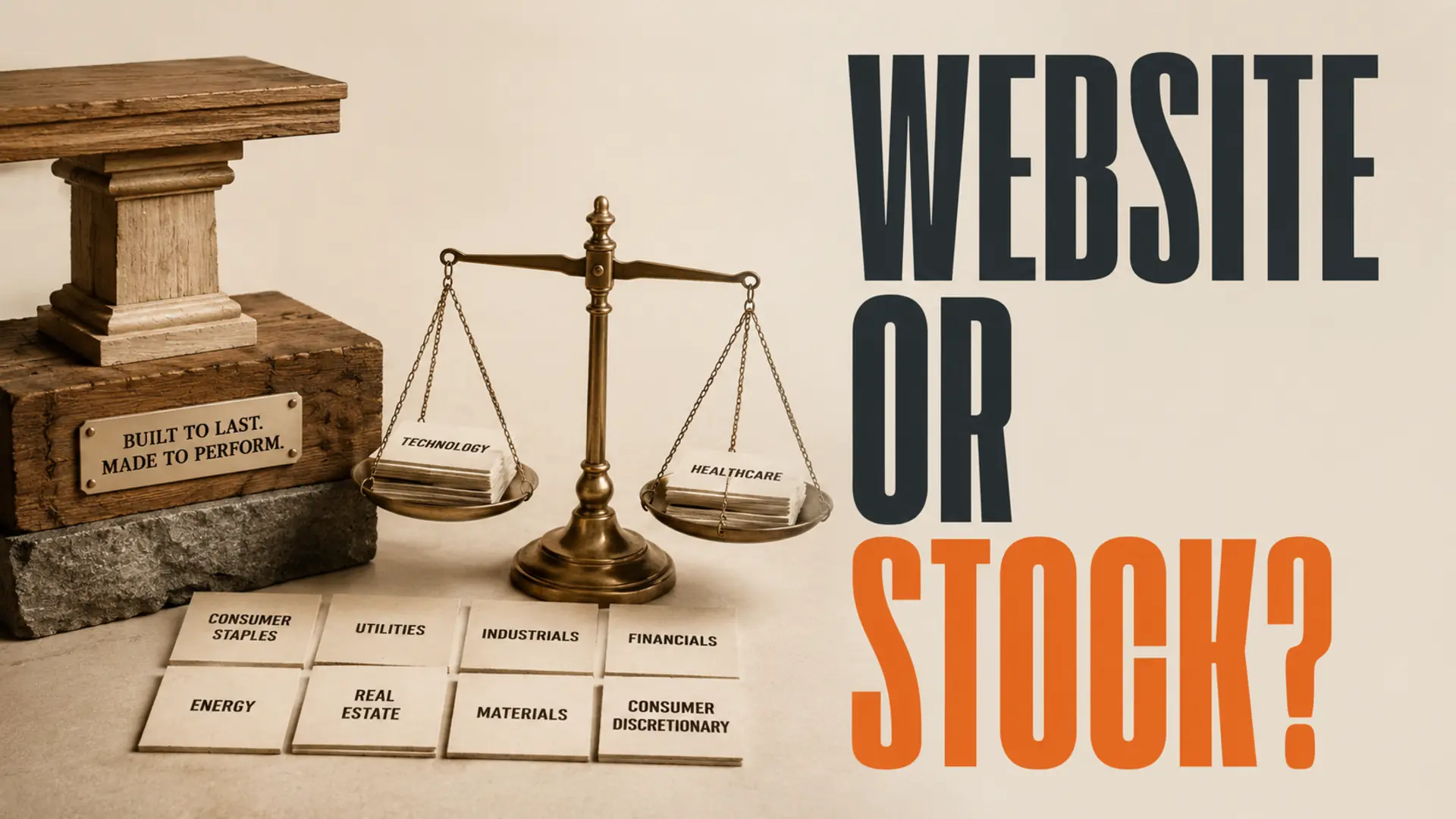
Should your next investment be a website or stocks? That is not a universal either-or decision. A diversified market investment is a financial asset that can be relatively passive and liquid. A website business is an operating asset: concentrated, hands-on, difficult to value and capable of losing the full amount invested.
A website may be the better use of a limited business-development budget when you have validated customers, relevant skills and time to operate it. Stocks may be more appropriate for long-term financial goals, diversification and capital you do not want tied to one small venture. This article is educational and not personalized investment advice.
Website Business vs. Stocks: What Are You Actually Buying?
| Factor | Diversified market investment | Website business |
|---|---|---|
| Role | Investor | Owner-operator |
| Control | Limited | Direct, within market and platform constraints |
| Diversification | Potentially broad | Usually concentrated in one offer and audience |
| Liquidity | Often easier to buy or sell | No guaranteed buyer or sale timeline |
| Labour | Can be relatively passive | Requires sales, delivery, maintenance and compliance |
| Return | Uncertain market return | Uncertain business profit or loss |
The Case for Building a Website Business
You can influence the operating decisions
An owner can refine the offer, improve customer service, change pricing, build partnerships and decide how the website supports sales. That control is useful only when decisions are informed by real customer evidence.
You can combine capital with skill and labour
A small business can grow because the owner contributes expertise, relationships and time—not because the website itself produces an automatic return. When comparing outcomes, include the market value of that labour.
The website may strengthen an existing business
For an established service company, a clearer site can support enquiries, customer education, scheduling and operations. The value may appear through better processes rather than a separate stream of “digital asset” income.
You can test before making a large commitment
A lean page, manual workflow and small paid pilot can reveal whether customers care. Follow a structured process to validate an online business idea before building a large platform.
The Risks a Website Investment Cannot Diversify Away
- Demand risk: the intended customers may not buy.
- Execution risk: the offer, positioning or service may be weak.
- Platform risk: search engines, social networks, payment providers or marketplaces can change.
- Concentration risk: one website may depend on one niche, geography, supplier or owner.
- Security and privacy risk: incidents can create costs and damage trust.
- Key-person risk: the operation may stop when the owner is unavailable.
- Liquidity risk: a profitable-looking site may still be difficult to sell.
Investor.gov explains that all investments involve uncertainty and possible financial loss. Its overview of investment risk also distinguishes risks such as business risk and liquidity. A privately operated website business can carry several of these risks at once.
Why Diversification Still Matters
A single website is not a substitute for a diversified financial plan. Diversification spreads exposure among assets so one failure has less effect on the whole portfolio. Investor.gov’s March 31, 2026 bulletin describes diversification as investing across assets to reduce overall portfolio risk.
Read the official Investor.gov Tips for 2026. Canadians should obtain advice suited to Canadian accounts, tax rules and personal circumstances from an appropriately qualified professional.
Do Not Compare Business Revenue With Investment Return
A common mistake is comparing gross business revenue with the percentage return on a financial portfolio. They are not equivalent.
For a website business, calculate:
- Gross sales actually collected
- Refunds, payment fees and bad debt
- Advertising and customer-acquisition costs
- Software, hosting, contractors and support
- Insurance, accounting, legal and compliance costs
- Replacement cost for the owner’s labour
- Taxes and reinvestment required to maintain the operation
What remains is closer to operating profit, but even that is not guaranteed to continue. Avoid applying an arbitrary valuation multiple without verified financial records, transferable systems, diversified customers and evidence of sustainable earnings.
Questions to Ask Before Funding a Website Business
- Do I have emergency savings and money for near-term obligations?
- Can I afford to lose the entire project budget?
- Have real customers confirmed the problem and offer?
- What will I personally need to do each week?
- Which permissions, licences, privacy duties or industry rules apply?
- How dependent is the model on Google, one client or one supplier?
- Who owns the domain, code, content, accounts and customer data?
- What evidence would make me stop, revise or invest more?
A Safer Capital-Allocation Sequence
- Protect essentials. Do not use rent, tax, payroll or emergency money for an unproven project.
- Define the risk budget. Set an amount you can lose without disrupting core goals.
- Validate manually. Interview customers and test the offer before automating it.
- Build the smallest useful version. Add only what the customer journey requires.
- Measure contribution and hours. Track profit after direct costs and the owner workload.
- Separate business and personal finances. Maintain clear records and obtain relevant professional advice.
- Diversify gradually. Avoid allowing one website or one acquisition channel to become your entire financial plan.
If a build is justified, review the process from idea to live website and the practical guide to starting an online business while working full-time.
When Each Option May Fit Better
A website business may fit when
- You have validated demand and relevant operating skills.
- You want to actively build a business rather than make a passive investment.
- You can tolerate concentration, illiquidity and the possibility of total loss.
- The project strengthens a credible existing business or tested offer.
A diversified investment may fit when
- Your priority is a long-term financial goal rather than operating a company.
- You value diversification, liquidity and lower day-to-day involvement.
- You do not have time or interest in sales, service, technology and compliance.
- You want an approach that can be aligned with a broader financial plan.
The two approaches can coexist, but they should not be marketed as interchangeable or guaranteed paths to wealth.
Frequently Asked Questions
Validate the Business Before Funding the Build
TruWebz helps Canadian entrepreneurs turn tested customer demand into focused websites with clear ownership, manageable operations and measurable outcomes.