
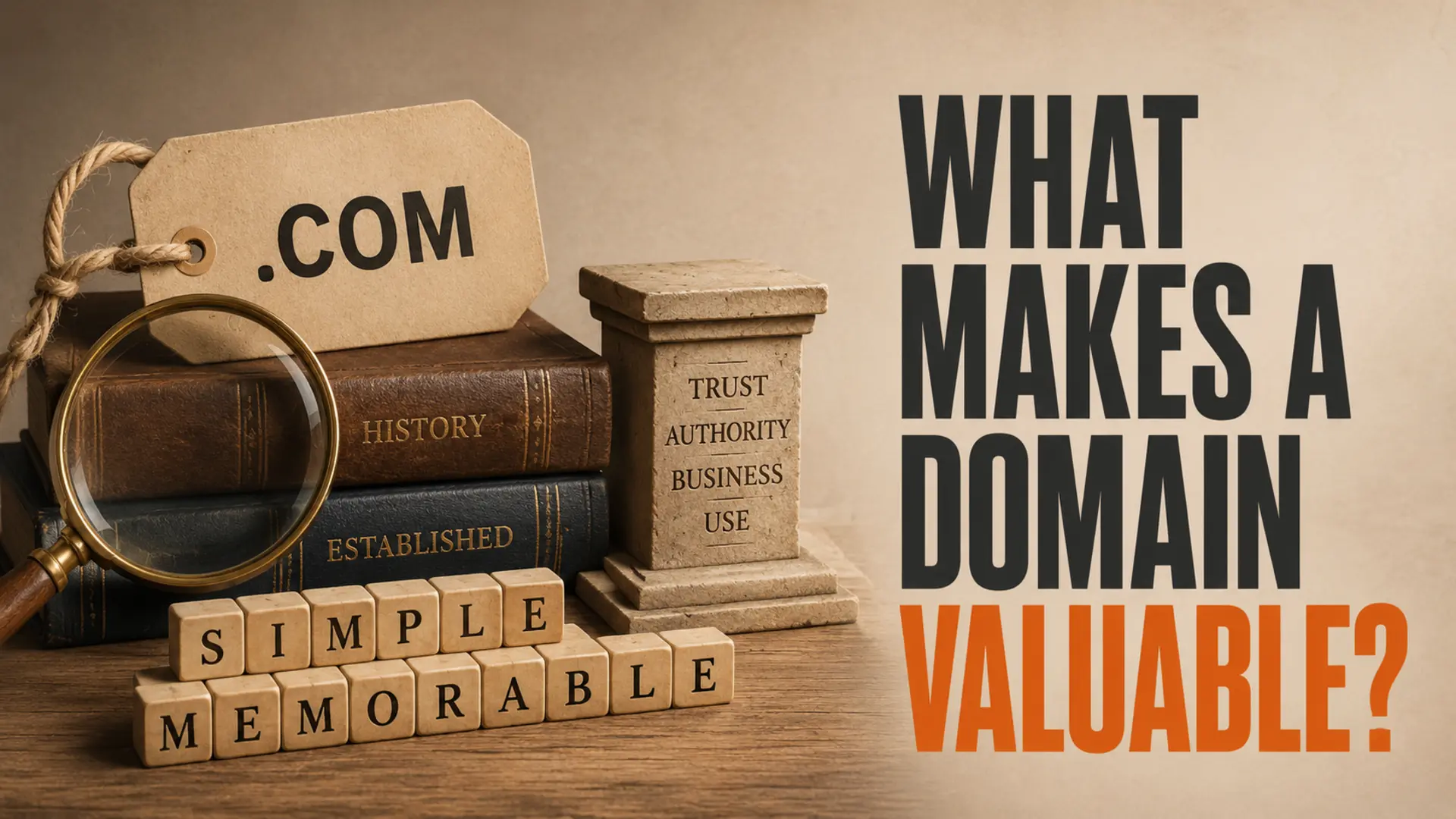
The short version: Domain name valuation is not a precise formula. A credible estimate considers commercial usefulness, extension fit, memorability, ownership and history, and whether a real business or audience is attached. Automated appraisals can be a starting point, but a domain is ultimately worth what a qualified buyer is willing to pay under actual market conditions.
What makes a domain name valuable in 2026? The strongest domains are easy to understand, appropriate for their market, legally usable and useful to a realistic buyer. Some names have broad demand; others matter mainly to one company or one local market. That difference makes domain valuation highly contextual.
A registration fee does not establish market value, and an automated estimate is not an offer. Before renewing, developing or buying a name, assess the five domain name valuation factors below and document the evidence behind each conclusion.
The Five Domain Name Valuation Factors
1. Commercial Usefulness and Buyer Demand
A valuable domain gives a buyer a clear reason to own it. It may describe a service, support a memorable brand, protect an established identity or provide a concise address for a useful product. The important question is not simply whether keywords appear in the name; it is whether credible buyers can use it without confusing customers.
Consider the size and quality of the buyer pool:
- How many legitimate organizations could use the name?
- Is the term connected to a real product, service or audience?
- Does it create a clear advantage over readily available alternatives?
- Would the likely buyer face trademark, regulatory or reputational concerns?
Exact-service domains can be clear, especially in local markets, but they may have a narrow buyer pool. Invented brand names can serve a broader concept, but usually require more explanation and marketing. Neither category is automatically more valuable.
2. Extension Fit and Market Trust
The extension should suit the intended audience and use. A .ca address can signal a Canadian connection, while .com is widely recognized for businesses operating across markets. Industry or newer extensions can work when audiences understand them, but familiarity, availability and renewal terms should be evaluated rather than assumed.
An extension alone does not guarantee trust or search visibility. Content quality, reputation, usability and how the business is represented matter far more than a simplistic hierarchy. For Canadian businesses, confirm the current eligibility and registration rules with the registry or registrar before acquiring a .ca name.
3. Memorability and the Verbal Test
A good domain is easy to hear, remember, type and share. Say it once without showing it on a screen, then ask another person to repeat and spell it. This exposes friction that an owner may overlook.
Common sources of confusion include:
- unexpected spelling or word order;
- hyphens and numbers that must be explained;
- words that sound alike but are spelled differently;
- ambiguous abbreviations;
- length that makes typing and recall difficult.
There is no universal character-count rule. A slightly longer, clear name can be more useful than a short but ambiguous one. Pronunciation, meaning and customer context should guide the decision.
4. Ownership, Legal Risk and Domain History
Before discussing price, verify that the seller controls the registration and that the transfer can be completed safely. The ICANN Registration Data Lookup can help research registration information for supported domains, although privacy services may limit what is displayed.
Review the name for trademark conflicts and misleading similarity. For Canada, search the official Canadian Trademarks Database. A database search is useful due diligence, not a legal opinion; obtain qualified advice when the risk or transaction value warrants it.
History also matters, but age is not a guaranteed ranking asset. Check prior site content, redirects, security incidents, spam, disputes and the relevance of existing links. Google defines expired-domain abuse as repurposing an expired name mainly to manipulate rankings with low-value content. A clean, relevant history may reduce risk, but it does not promise rankings or traffic.
For a deeper acquisition checklist, review how to evaluate an expired domain before building on it.
5. An Operating Business or Proven Audience
A domain by itself is different from a functioning digital business. When a transaction includes a website, verified traffic, customers, content, systems or recurring revenue, buyers are valuing more than the name. Those assets should be separated and assessed individually.
Evidence may include analytics access, financial records, customer concentration, contracts, operating costs, intellectual-property ownership, traffic sources and transferability. A website that depends entirely on one owner, one customer or unstable search traffic may deserve a lower valuation than its headline revenue suggests.
Do not apply an arbitrary multiplier or assume that development automatically increases value. A useful website can make a domain more commercially relevant, but poor content, legal exposure, unreliable earnings or expensive maintenance can reduce the combined asset’s appeal. Our guide to website asset value drivers explains this distinction in more detail.
How to Estimate a Domain’s Value Responsibly
Define What Is Included
Clarify whether the sale covers only the domain or also a website, content, email accounts, social profiles, customer data, contracts, code, analytics and brand assets. Each item needs documented ownership and a safe transfer process.
Identify Realistic Buyers
List organizations that could use the name without infringing rights or confusing customers. A long list of hypothetical companies is less meaningful than a few verified buyers with a plausible business case.
Review Comparable Sales Carefully
Comparable sales can provide context when the names share similar length, language, extension, industry, buyer pool and transaction conditions. Public reports may omit private terms, bundled assets or brokerage fees, so treat them as reference points rather than a formula.
Use More Than One Valuation Method
Compare market evidence, replacement alternatives, buyer usefulness and—when a genuine operating business is included—verified financial performance. Document assumptions and present a range rather than false precision.
Account for Transaction Costs and Risk
Renewals, brokerage, escrow, taxes, legal review, transfer requirements and potential disputes affect the net result. Use a reputable transfer process and never rely on an unsolicited buyer’s payment link or appraisal requirement.
A Practical Domain Review Checklist
- Write the intended use in one sentence.
- Identify the realistic buyer pool and available alternatives.
- Test pronunciation, spelling and recall with people unfamiliar with the name.
- Confirm extension rules, renewal costs and transfer eligibility.
- Research registration history, past content, links and security concerns.
- Search relevant trademarks and business names.
- Separate the raw domain from any website or operating-business value.
- Compare credible sales while noting meaningful differences.
- Set a valuation range and record every assumption.
- Use secure escrow and appropriate professional advice for material transactions.
If the domain is part of a new venture, validate the customer problem before funding a large build. This online business validation framework provides a lean starting point.
When an Automated Domain Appraisal Helps
An automated tool can organize signals such as length, extension, keyword patterns and reported sales. It can be useful for sorting a large portfolio or creating questions for further review. It cannot know a buyer’s strategy, undisclosed comparable-sale terms, trademark risk, seller urgency or whether a bundled business is genuinely transferable.
Use automated figures as one input. A high estimate is not proof of liquidity, and a low estimate does not mean a strategically important name has no value to a particular buyer.
Build Value Without Making Unsupported Claims
If a domain has a credible use, develop it around real customer needs. Publish accurate content, make ownership clear, secure the site, measure genuine engagement and establish an operating process. Avoid creating thin pages, buying links or repurposing unrelated history merely to influence search results.
TruWebz can help assess whether a domain supports a sensible website concept and plan the smallest useful version to validate it. Development should follow evidence, clear ownership and realistic operating requirements—not an appraisal widget or a guaranteed resale forecast.
Have a Domain With a Practical Business Idea?
Talk with TruWebz about validating the concept and building a clear, credible website around real customer needs.
Frequently Asked Questions
What makes a domain name valuable?
Value usually comes from commercial usefulness, extension fit, memorability, clean ownership and history, and demand from realistic buyers. A functioning website or business must be valued separately from the raw domain.
Are automated domain appraisals accurate?
They can provide a rough reference, but they cannot determine an actual sale price. Buyer strategy, legal risk, market liquidity, private sale terms and bundled assets require human review.
Does an older domain rank better?
Age alone does not guarantee rankings. Past content, relevance, link quality, security history and the value of the new site matter. Repurposing a domain mainly to manipulate search can violate Google’s spam policies.
Is a .ca domain more valuable than a .com?
It depends on the intended market and buyer. A .ca may fit a Canadian organization, while a .com may suit broader use. The name, audience, eligibility and alternatives all affect value.
Does building a website increase domain value?
A useful website can create additional value when it has transferable content, systems, audience or verified earnings. Development cost alone does not establish resale value.
What should I check before buying a domain?
Confirm ownership and transferability, inspect prior use and links, review extension rules and renewals, search trademarks, assess realistic buyers and use secure escrow for a material purchase.